
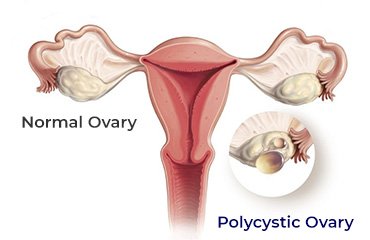

Polycystic ovary disease (PCOD) and polycystic ovary syndrome (PCOS) are two common conditions that affect the ovaries and cause hormonal imbalance in a female body at reproductive age.
People tend to get confused by the two, but they are actually quite different. Here we will study in depth about PCOS and PCOD, it’s key differences and Symptoms.
Difference Between PCOS and PCOD
PCOS– Polycystic Ovary Syndrome is a metabolic disorder where a woman gets affected by hormonal imbalance during the reproductive years i.e., the age group from 12 to 51 years.
PCOS is a broader syndrome characterized by many factors like hormonal imbalance, irregular menstrual cycles, and the presence of cysts. In addition to these, it also involves an increase in the level of male hormones like testosterone.
PCOS is severe as it can have broader effects on a woman’s health, including fertility issues, insulin resistance, weight gain, and an increase in the risk of metabolic disorders like diabetes. Women facing fertility challenges can consider IVF treatment in Delhi as a hopeful solution to start their family journey.
On the other side, PCOD—polycystic ovarian Disease—is more of a medical condition where the woman’s ovaries produce partially mature or immature eggs in large numbers, and over time they convert and turn into cysts in the ovaries. A cyst is a sac-like structure, or a pocket of tissue, filled up with air or other substances and can be formed in any part of the body.
PCOD is primarily diagnosed based on the presence of multiple cysts developed on the ovaries and irregular menstrual cycles.
It is mainly associated with irregular menstrual cycles. PCOD is generally considered as more of a milder form than in comparison to PCOD.
The exact causes of PCOS and PCOD are not understood, but both are thought to be associated with a combination of genetic factors and environmental factors, which can include hormonal imbalances, insulin resistance, and inflammation.
What Causes PCOS and PCOD?
The causes of polycystic ovaries are not so well known; however, various factors seem to cause these conditions. Some of the potential causes include the following:

Hormonal Imbalance – The main issue of both PCOS and PCOD is hormonal imbalance of reproductive hormones. The androgen level, which is higher in the case of females suffering from the disease, prevents proper development and release of eggs in the menstrual cycle. It eventually leads to the formation of cystic ovaries.
Genetics – If your mother, sister, or other female relatives have or had PCOS and PCOD in the past, then there is a higher chance that you may develop it too. Research says that genetics play a major role in the development of those conditions.
Insulin Resistance – One of the major causes of PCOS is insulin resistance. Whenever the body becomes resistant to insulin, it tends to produce more of it. High amounts of insulin stimulate the ovaries to produce more androgens, causing bilateral polycystic ovaries and other symptoms, such as weight gain and acne.
Inflammation – Women with PCOS often experience low-grade inflammation, which could encourage the ovaries to release some androgens. Chronic inflammation has been said to contribute to different ailments. Heart diseases are one of such ailments. Another risk factor for PCOS is heart disease.
Lifestyle Factors – Diet and exercise also play a role in the development of PCOS or PCOD. A diet full of processed foods and a sedentary lifestyle can make the level of insulin resistance increase, thereby increasing the symptoms.
Symptoms of PCOS and PCOD
They can be quite different from one individual to another but, from the symptoms, can be quite mild or extreme. These conditions are sometimes occult, and one may not even know if he/she is affected unless he/she does not experience any symptom that would raise the suspicion.
Symptoms of PCOD
- Irregular or delayed periods or absence of periods at all.
- Heavy menstrual flow.
- Weight gain or loss trouble.
- Insulin resistance or diabetes of type 2
- Hypertension
- Fatigue
- There might be a general trend for excess hair to grow in the face, chest, abdomen, or back.
- Problems with acne or oiliness
Mood swings and even symptoms of depression can be initiated by menopause.
They can be quite different from one individual to another but, from the symptoms, can be quite mild or extreme. These conditions are sometimes occult, and one may not even know if he/she is affected unless he/she does not experience any symptom that would raise the suspicion.
Symptoms of PCOS
Unpredictable periods (without any particular pattern) or no periods at all.
Menorrhagia, or heavy bleeding during periods
The development of obesity or the inability to lose weight.
Insulin resistance or type 2 diabetes.
Hypertension (affectional pressure on blood)
Fatigue
Mood swings or depression
Sustained abnormal growth of hair on the face, chest, stomach, or back
Acne or greasy skin
Difficulty getting pregnant
Pelvic pain or discomfort may exist.
Darkening of the skin in the neck, groin, or armpits is known as hyperpigmentation.
How to treat PCOS and PCOD?
There is particularly no such cure for PCOS and PCOD, but a variety of PCOS treatment clinic in Delhi can help you manage it.
1. Diet: Diet Should be low GI (glycaemic diet), i.e., (eating foods that have less effect on sugar levels) with plenty of whole grains, vegetables, fruits, and lean proteins. The diet will thus help stabilize the blood sugar level and reduce the level of insulin resistance.
2. Exercise: Regular physical activity can help with weight loss, improve mood, and regulate hormone levels.
3. Weight Management: A loss of as little as a few kilograms of body weight improves symptoms such as irregular periods and insulin resistance. One study showed that even a 5-10% body weight loss can significantly make a difference.
4. Medication: If these lifestyle changes are not helpful, drugs will be prescribed for symptom management as well.
For example, hormonal therapies may help restore regular menstrual periods, reduce levels of androgens, and consequently manage symptoms of acne and excess hair growth. Some diabetes medication may be prescribed to help women with PCOS insulin sensitivity and regulate their menstrual cycle.
5. Surgical Treatment: Some medical practitioners will often advise surgery for some cases. Laparoscopic ovarian drilling destroys a small piece of the ovaries, so the level of androgens decreases and possibly stimulates ovulation. It’s usually done last once other treatments haven’t been of help.
Conclusion
Making health decisions is really dependent on knowing the difference between PCOs (polycystic ovarian syndrome) and PCOD (Polycystic Ovarian Disease). Although the two conditions share common grounds by affecting the ovaries and hormonal balance, they vary in terms of severity, approach to treatment, and long-term implications for health. PCOD may be managed by lifestyle changes, while PCOS requires more aggressive treatment by using drugs and frequent follow-up visits.
Early detection and appropriate management may avoid complications and achieve a state of hormonal balance that is in the best interest of your fertility. For irregular periods, weight gain, acne, or similar symptoms, the first step towards better health is getting professional advice.
For professional treatments and individualized care, we recommend Origyn IVF, New Delhi, Our specialists provide multifaceted treatment, from initial hormonal testing through complex therapies, so be assured that, at every moment, you will receive the greatest care possible with us on the path to achieving wellness.
Visit our website and book an appointment today from our website OrigynIVF take the road to a stronger and a healthier self.
People also ask for-
https://youtu.be/nVLcW–adZM
About Dr. Rashmi Sharma
Dr. Rashmi Sharma is an IVF specialist Consultant Reproductive Medicine and Director Origyn Fertility & IVF New Delhi MBBS (BHU), MD(BHU), DNB, MNAMS, FICOG, Diploma IVF and reproductive Medicine (Kiel University, Germany) Web Editor, Indian Fertility Society (2024-26) Former HOD, IVF dept, Moolchand Hospital, Delhi (2009-13) and Max Hospital, Pitampura, Delhi (2013-17), Director, Origyn Fertility & IVF, which has 4 branches across Delhi.
Origyn IVF has been accredited for 1-year fellowship in IVF and reproductive medicine along with an MSc in Clinical Embryology under Amity University and IFS Collaboration. Recipient of the “C. S. Dawn Award” for best paper presentation on her work on IVF /ICSI with genital tuberculosis, at All India Congress Of Obstetrics and Gynecology (AICOG 2010) Recipient of “Hall of Fame – Best IVF specialist in India – North” at Economic Times – National Fertility Awards,2019 and 2023 & 2024.
Origyn IVF received “Best IVF center in North India” and “Most integrated team in IVF, India – North” at Economic Times – National Fertility Awards, 2019 & 2024 Recipient of “Best IFS Executive” at Fertivision – 2018, Kochi. Authored various chapters in infertility books of repute. Many national and international paper presentations and publications.
Recent Comments