
Best Hysteroscopy Treatment in West Delhi, 2026
Share with your friends
About Dr. Rashmi Sharma
Dr. Rashmi Sharma is an IVF specialist, Consultant Reproductive Medicine, and Director Origyn Fertility & IVF, New Delhi. She holds MBBS (BHU), MD (BHU), DNB, MNAMS, FICOG, and a Diploma in IVF & Reproductive Medicine (Kiel University, Germany). Web Editor, Indian Fertility Society (2024–26). Former HOD, IVF Department, Moolchand Hospital, Delhi (2009–13) and Max Hospital, Pitampura, Delhi (2013–17). Director, Origyn Fertility & IVF, which has 4 branches across Delhi.
Origyn IVF has been accredited for a 1-year fellowship in IVF and Reproductive Medicine, along with an MSc in Clinical Embryology under Amity University and IFS collaboration.
Recipient of the “C. S. Dawn Award” for best paper presentation on IVF/ICSI with genital tuberculosis at the All India Congress of Obstetrics and Gynecology (AICOG 2010).
Recipient of the “Hall of Fame – Best IVF Specialist in India – North” at the Economic Times National Fertility Awards in 2019, 2023, and 2024.
Origyn IVF received the “Best IVF Center in North India” and “Most Integrated Team in IVF – North” at the Economic Times National Fertility Awards in 2019 and 2024.
Recipient of the “Best IFS Executive” award at Fertivision 2018, Kochi. Authored various chapters in reputed infertility textbooks with numerous national and international publications and presentations.
Contact Us
Introduction
If a doctor has recently mentioned hysteroscopy to you — whether during a fertility workup, after repeated implantation failure, or simply as part of investigating irregular bleeding — it’s natural to have questions. What actually happens during the procedure? Does it hurt? Will it help you conceive? And, practically speaking, where can you get it done well if you live in West Delhi and don’t want to cross the city for every appointment, especially when a follow-up visit is often part of the process? This is especially true if you’re specifically researching hysteroscopy treatment in West Delhi rather than settling for the nearest available clinic.
This guide walks through hysteroscopy in detail: what the procedure involves, the conditions it diagnoses and treats, what recovery actually looks like, and what to consider when choosing a centre for hysteroscopy treatment in West Delhi. We’ll also look at how Origyn Fertility & IVF, which has a dedicated centre in Vikaspuri, approaches this procedure as part of its broader fertility evaluation process.
What Exactly Is Hysteroscopy?
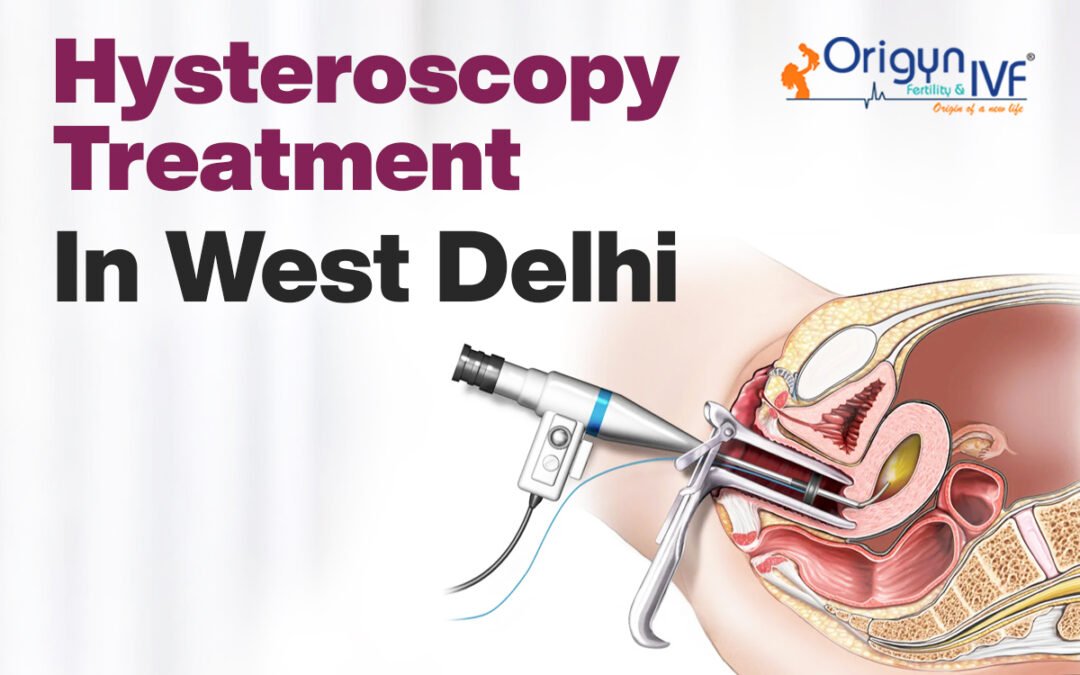
Hysteroscopy is a procedure that lets a doctor look directly inside the uterus using a thin, lighted instrument called a hysteroscope, which is passed through the vagina and cervix without any external incision. Unlike an ultrasound, which gives an indirect picture built from sound waves, hysteroscopy gives a direct, real-time view of the uterine cavity — the actual lining, its shape, and anything unusual growing inside it.
It’s used in two broad ways. Diagnostic hysteroscopy is purely for looking and identifying a problem — polyps, fibroids, scar tissue, a septum, or unusual thickening of the lining. Operative hysteroscopy goes a step further: once something is spotted, small surgical instruments can be passed through the same hysteroscope to remove or correct it in the same sitting, often without needing a separate procedure later. This combination of diagnosis and treatment in one visit is a large part of why hysteroscopy has become such a routine part of fertility evaluations over the last decade or so. This is exactly the kind of detail that makes hysteroscopy treatment in West Delhi such a practical consideration for patients who want both diagnosis and correction handled together.
Why Hysteroscopy Matters So Much in Fertility Treatment
A surprising number of fertility cases labelled “unexplained infertility” turn out to have a structural cause hiding inside the uterus — one that standard blood work and ultrasounds simply don’t catch clearly enough. This is really the reason hysteroscopy gets recommended so often before or during fertility treatment, and why a properly equipped facility offering hysteroscopy treatment in West Delhi matters for people who don’t want to keep travelling across the city for each stage of their evaluation.
The uterine cavity has to be genuinely hospitable for an embryo to implant and grow. Even a technically excellent embryo, created through a well-run IVF cycle, can fail to implant if the space it’s being placed into has a polyp in the way, scar tissue reducing its size, or a dividing wall (septum) splitting the cavity. Hysteroscopy is often the only reliable way to catch these issues before they quietly derail an otherwise well-managed treatment cycle. This is one more reason hysteroscopy treatment in West Delhi is increasingly sought out by patients navigating IVF setbacks
Conditions Hysteroscopy Can Diagnose and Treat
Several specific conditions are commonly identified and, where possible, corrected during hysteroscopy:
Uterine polyps — small, usually benign growths on the inner lining of the uterus that can interfere with implantation or cause irregular bleeding. These can typically be removed in the same sitting as diagnosis.
Submucosal fibroids — fibroids that grow into the uterine cavity itself, rather than staying within the muscular wall. Depending on size and location, these can distort the cavity enough to affect implantation.
Uterine septum — a congenital condition where a band of tissue partially or fully divides the uterine cavity. This is one of the more common findings in women with recurring miscarriage, and it can often be corrected surgically through hysteroscopy.
Intrauterine adhesions (Asherman’s Syndrome) — scar tissue inside the uterus, often resulting from a prior surgical procedure like a D&C, which can partially or completely obliterate the uterine cavity. This condition is a well-documented but frequently missed cause of repeated implantation failure and unexplained infertility.
Endometrial thickening or abnormalities — unusual patterns in the lining that might need a biopsy for further evaluation.
Retained products of conception — tissue remaining in the uterus after a miscarriage or delivery, which can sometimes go undetected on a standard ultrasound.
Each of these conditions responds differently to treatment, and this is exactly where an experienced hysteroscopic surgeon makes a real difference — precision matters enormously when working inside a cavity as sensitive as the uterus. Patients seeking hysteroscopy treatment in West Delhi are often surprised by how many of these conditions can be corrected in the very same sitting as diagnosis.
It’s worth understanding that many of these conditions produce very few obvious symptoms on their own, which is part of why they go undiagnosed for so long. A small polyp might cause nothing more than slightly irregular spotting between periods, easy to dismiss as unremarkable. A mild uterine septum often produces no symptoms at all until a woman experiences one or more first-trimester miscarriages, at which point doctors start looking more closely at uterine anatomy. Mild intrauterine adhesions can sometimes reduce period flow so gradually that a woman doesn’t notice the change until someone specifically asks about it during a fertility consultation. This is precisely why doctors increasingly recommend a hysteroscopic evaluation proactively, particularly for women who’ve had a prior uterine surgery, a D&C, or more than one unexplained IVF failure, rather than waiting for symptoms to become obvious enough to demand attention on their own.
Who Typically Needs This Procedure
Hysteroscopy isn’t only for people already undergoing IVF. It’s commonly recommended for:
- Women experiencing repeated IVF or IUI failure, where a structural cause hasn’t yet been ruled out.
- Women with a history of recurrent miscarriage.
- Abnormal or heavy uterine bleeding that hasn’t responded to simpler treatment.
- An abnormal finding on ultrasound or an HSG (hysterosalpingogram) test that needs closer examination.
- Suspected intrauterine adhesions, particularly after a prior D&C or uterine surgery.
- Removal of a misplaced IUD that can’t be retrieved through simpler means.
For many of these patients, hysteroscopy treatment in West Delhi offers a practical way to get a clear answer without unnecessary delay. If your doctor has suggested hysteroscopy, it’s usually because something on an earlier scan or test result didn’t look entirely clear, and a direct look is the most reliable way to know for certain rather than guessing based on indirect imaging
What Actually Happens During the Procedure
Understanding the steps involved tends to ease a lot of the anxiety patients feel walking in. Here’s what a typical hysteroscopy procedure generally involves:
- Pre-procedure evaluation. Basic blood tests, a pregnancy test if relevant, and a discussion of your specific symptoms or diagnostic concern.
- Anaesthesia. Depending on whether the procedure is purely diagnostic or involves treatment, this can range from local anaesthesia to a short general anaesthetic for more involved operative procedures.
- Insertion of the hysteroscope. The thin scope is passed through the cervix into the uterine cavity, which is typically distended slightly with a sterile fluid or gas to allow a clearer view.
- Examination. The doctor examines the lining, shape, and any visible abnormalities on a connected screen.
- Treatment, if needed. If a polyp, fibroid, adhesion, or septum is found and is treatable in the same sitting, small instruments are passed through the hysteroscope to correct it.
- Recovery. Most diagnostic procedures take well under thirty minutes, and patients are typically monitored for a short period afterward before going home the same day.
Across most facilities offering hysteroscopy treatment in West Delhi, this overall structure — evaluation, anaesthesia, examination, treatment if needed, and recovery — remains fairly consistent. The entire process, for most patients, is far less intimidating in practice than it sounds on paper — largely because it doesn’t involve any external cuts, and recovery is generally much quicker than a traditional surgical procedure.
What Recovery Actually Looks Like
Recovery time depends heavily on whether the procedure was purely diagnostic or involved active treatment, and on the specific condition being addressed. Recovery timelines are one of the most common questions patients ask before booking their first appointment.
For a simple diagnostic hysteroscopy, most women feel back to normal within a day or two, sometimes experiencing mild cramping or light spotting similar to a light period. For operative procedures — removing a polyp, correcting a septum, or clearing adhesions — recovery can take anywhere from a few days to a few weeks, depending on the extent of the correction.
In more complex cases, like moderate-to-severe Asherman’s Syndrome, full recovery and re-establishment of a healthy uterine lining can take anywhere from six weeks to several months, and doctors will often recommend hormonal support alongside follow-up scans to confirm the cavity has healed properly before attempting conception or a subsequent embryo transfer. Patience during this window matters — rushing back into treatment before the lining has genuinely recovered tends to reduce the chances of success rather than speed things up.
A few practical points worth keeping in mind during recovery, regardless of which type of procedure you’ve had: light spotting for a few days is normal and shouldn’t cause alarm, but heavier bleeding, fever, or significant pain should be reported to your doctor promptly. Most doctors advise avoiding intercourse, tampons, and swimming for a short period after the procedure to reduce infection risk, particularly if any tissue was removed or corrected. Mild pain relief, if needed, is usually enough to manage any discomfort, and most women don’t require anything stronger than what would typically be used for period cramps.
Choosing a Centre for Hysteroscopy Treatment in West Delhi
If you live in or around West Delhi, travelling across the city for a procedure like this — particularly one that might need a follow-up visit or two — adds a layer of stress that’s easy to underestimate. This is one practical reason it’s worth looking specifically for hysteroscopy treatment in West Delhi, rather than defaulting to a hospital purely because it has a bigger name, if the actual clinical quality is comparable.
These considerations matter just as much as location when evaluating hysteroscopy treatment in West Delhi options near you. A few things worth checking before choosing where to have the procedure done:
- Experience of the surgeon specifically with hysteroscopic techniques, not just general gynaecological surgery.
- Whether the facility can move from diagnostic to operative hysteroscopy in the same sitting, sparing you a second procedure later if something treatable is found.
- Access to proper imaging support, such as ultrasound or SIS (saline infusion sonography), used alongside hysteroscopy for more complete evaluation in complex cases.
- Follow-up care, particularly for conditions like Asherman’s Syndrome, where confirming the cavity has healed properly is just as important as the initial procedure.
- Clear communication about findings, since patients are often anxious about what was actually discovered and what it means going forward.
Facilities that combine strong clinical experience with easy accessibility tend to make hysteroscopy treatment in West Delhi far less stressful for patients already juggling multiple appointments.
Why Origyn Fertility & IVF Is a Practical Option for Hysteroscopy Treatment in West Delh
Origyn Fertility & IVF, under the direction of Dr. Rashmi Sharma, has built a specific focus on advanced diagnostic fertility evaluation, including minimally invasive hysteroscopic procedures. The centre’s approach treats hysteroscopy not as an isolated procedure, but as one part of a broader, evidence-based diagnostic process that also draws on ultrasound, SIS, and hysteroscopy-based adhesion mapping for more complex cases like Asherman’s Syndrome.
With a centre located in Vikaspuri, Origyn provides a genuinely convenient option for patients specifically looking for hysteroscopy treatment in West Delhi, without needing to travel to Pitampura or further across the city for this particular procedure. This matters more than it might initially seem — hysteroscopy sometimes requires a follow-up scan or a second look after treatment, and having a nearby, familiar centre for that continuity of care removes one more layer of logistical stress from an already demanding process.
Dr. Rashmi Sharma’s own background adds meaningful depth here. Her qualifications include an MD from BHU, DNB, MNAMS, and FICOG, along with specialised IVF and reproductive medicine training from Kiel University in Germany. She has previously headed IVF departments at both Moolchand Hospital and Max Hospital, Pitampura, giving her extensive hands-on experience diagnosing and treating exactly the kind of uterine conditions hysteroscopy is designed to address. Her background is part of why so many patients choose her centre specifically for hysteroscopy treatment in West Delhi.
The centre’s broader philosophy also matters here. Rather than treating hysteroscopy as a standalone, mechanical procedure, the team approaches it as one part of a fuller investigative picture — combining it, where relevant, with saline infusion sonography and detailed ultrasound assessment to build a more complete map of the uterine cavity before deciding on the right corrective approach. For conditions like Asherman’s Syndrome, where the extent and location of adhesions varies enormously from one patient to another, this kind of layered, site-specific evaluation tends to produce better outcomes than a one-size-fits-all surgical approach. It also means fewer surprises during the procedure itself, since the surgical team already has a clear sense of what to expect before the hysteroscope is even inserted. This layered approach is a key reason Origyn stands out among providers of hysteroscopy treatment in West Delhi.
What Happens After the Procedure
Once the procedure is complete, most patients receive a fairly detailed explanation of what was found, whether treatment was carried out in the same sitting, and what comes next. If nothing significant was found, this is genuinely useful information in itself — it rules out a structural cause and allows your doctor to focus attention elsewhere.
If a condition was identified and treated, follow-up typically includes a repeat scan after a few weeks to confirm proper healing, particularly for adhesions or septum correction, where the uterine cavity needs time to remodel and, in some cases, respond to hormonal support before it’s considered ready for conception or embryo transfer. This kind of structured follow-up is a standard part of quality hysteroscopy treatment in West Delhi, particularly for more complex corrective cases.
For women already undergoing IVF, doctors will usually recommend waiting at least one full cycle after hysteroscopy before proceeding with an embryo transfer, giving the lining adequate time to recover and respond normally to hormonal preparation.
Common Questions Patients Ask Before the Procedure
Is hysteroscopy painful?
Most women describe it as similar to period cramps rather than significant pain, particularly for diagnostic procedures. Operative procedures involving anaesthesia are generally not felt at all during the procedure itself, with some mild discomfort afterward.
How long does the whole appointment take?
Diagnostic hysteroscopy typically takes fifteen to thirty minutes, though the full appointment including preparation and recovery monitoring may run closer to an hour or two.
Can I go home the same day?
Yes, in the vast majority of cases. Hysteroscopy is almost always an outpatient procedure, and general anaesthesia, when used, is typically short-acting.
Will I need to take time off work?
For simple diagnostic procedures, most women return to normal activity within a day. For more involved operative procedures, a few days of rest is generally advisable, depending on what was treated
Does hysteroscopy guarantee pregnancy afterward?
No procedure can guarantee pregnancy, but correcting a structural issue that was genuinely interfering with implantation often meaningfully improves the chances of a subsequent IUI, IVF cycle, or natural conception, depending on the underlying diagnosis. This is why patients pursuing hysteroscopy treatment in West Delhi are encouraged to view it as one part of a broader fertility evaluation, not a guaranteed fix on its own.
Red Flags to Watch For When Choosing a Facility
Not every centre offering hysteroscopy has equal experience with more complex cases. A few things worth being cautious about:
- A facility that can’t clearly explain whether they can move from diagnostic to operative hysteroscopy in the same visit.
- Vague answers about who specifically will be performing the procedure.
- No mention of follow-up scanning for conditions like adhesions or septum correction, where confirming proper healing genuinely matters.
- Pressure to proceed with a costly package before a clear diagnostic conversation has taken place.
If you notice more than one of these, it’s reasonable to seek a second opinion before proceeding, particularly for more complex cases like suspected Asherman’s Syndrome or recurrent implantation failure. Watching for these signs is especially useful when comparing different options for hysteroscopy treatment in West Delhi
Understanding Cost and What's Typically Included
Cost for hysteroscopy varies depending on whether it’s purely diagnostic or involves operative correction, the type of anaesthesia used, and whether any additional imaging like SIS is needed alongside it. A simple diagnostic hysteroscopy under local anaesthesia is generally the least expensive option, while operative procedures requiring general anaesthesia and an overnight or day-care hospital stay cost more, largely due to the additional theatre time, anaesthesia charges, and any tissue analysis that might follow.
It’s worth asking upfront exactly what’s included in any quoted price — pre-procedure blood work, the anaesthesia charge, the procedure itself, and any follow-up scan are sometimes billed separately rather than as one bundled package. A transparent clinic will walk you through this before the day of the procedure rather than presenting a surprising final bill afterward. Cost transparency is one more factor worth weighing carefully when comparing hysteroscopy treatment in West Delhi providers.
Final Thoughts
Hysteroscopy is one of those procedures that sounds more intimidating on paper than it usually is in practice, and for many women dealing with unexplained infertility, recurrent miscarriage, or repeated IVF failure, it can be the single test that finally identifies what was actually going wrong. Having access to reliable hysteroscopy treatment in West Delhi means not having to choose between convenience and quality — a genuinely useful thing when you’re already managing the emotional and logistical weight of fertility treatment. For patients who’ve been putting off this evaluation simply due to distance or scheduling, reliable hysteroscopy treatment in West Delhi removes that barrier entirely.
Origyn Fertility & IVF’s Vikaspuri centre, backed by Dr. Rashmi Sharma’s extensive background in reproductive medicine and hysteroscopic surgery, offers a practical, well-supported option for patients in West Delhi who need this procedure done thoroughly and followed up properly. Whatever centre you ultimately choose, make sure you leave your first consultation with a clear understanding of what’s actually being investigated, what the procedure will involve, and what happens next depending on what’s found.
This article is intended for general informational purposes and does not replace a personalised medical consultation. Please speak directly with a qualified fertility specialist or gynaecologist about your specific symptoms and treatment options.
Ready to Get Answers?
If you’ve been advised to get a hysteroscopy, or you suspect a structural issue might be affecting your fertility, Origyn Fertility & IVF’s Vikaspuri centre offers a straightforward path to hysteroscopy treatment in West Delhi, backed by an experienced team and clear follow-up care. Whether you’ve been advised to have this done or simply want a second opinion, dependable hysteroscopy treatment in West Delhi is now easier to access than you might think.
Book a Consultation for Hysteroscopy at Origyn Fertility & IVF