• 80 80 80 90 84
  • info@origynivf.com
Curious About IVF? Let's Talk.
  • January 30, 2026

Laser Assisted Hatching: A Complete Guide 2025

Share with your friends

About Dr. Rashmi Sharma

Dr. Rashmi Sharma is an IVF specialist, Consultant Reproductive Medicine, and Director Origyn Fertility & IVF, New Delhi. She holds MBBS (BHU), MD (BHU), DNB, MNAMS, FICOG, and a Diploma in IVF & Reproductive Medicine (Kiel University, Germany). Web Editor, Indian Fertility Society (2024–26). Former HOD, IVF Department, Moolchand Hospital, Delhi (2009–13) and Max Hospital, Pitampura, Delhi (2013–17). Director, Origyn Fertility & IVF, which has 4 branches across Delhi.

Origyn IVF has been accredited for a 1-year fellowship in IVF and Reproductive Medicine, along with an MSc in Clinical Embryology under Amity University and IFS collaboration.

Recipient of the “C. S. Dawn Award” for best paper presentation on IVF/ICSI with genital tuberculosis at the All India Congress of Obstetrics and Gynecology (AICOG 2010).

Recipient of the “Hall of Fame – Best IVF Specialist in India – North” at the Economic Times National Fertility Awards in 2019, 2023, and 2024.

Origyn IVF received the “Best IVF Center in North India” and “Most Integrated Team in IVF – North” at the Economic Times National Fertility Awards in 2019 and 2024.

Recipient of the “Best IFS Executive” award at Fertivision 2018, Kochi. Authored various chapters in reputed infertility textbooks with numerous national and international publications and presentations.

Contact Us
Blank Form (#7)

Thinking how to increase your chances of a successful IVF journey?

With modern advancements in fertility treatments in 2025. IVF success rates have increased, offering new hope to many couples. A technique which is making a real difference is Laser Assisted Hatching (LAH) a precise and gentle method designed to enhance embryo implantation during IVF cycles.

At Origyn IVF, we are happy to integrate this technology into our treatment plans, helping to improve the likelihood of pregnancy, especially for those who have dealt with repeated implantation failures or are any other problem. LAH helps in easier hatching and attachment to the uterine lining which is an important step in the IVF process.

Our aim is to provide the patients with the best results that has expert guidance with the latest technology in this treatment.

Laser Assisted Hatching

What is Laser Assisted Hatching & Who Need This Treatment?

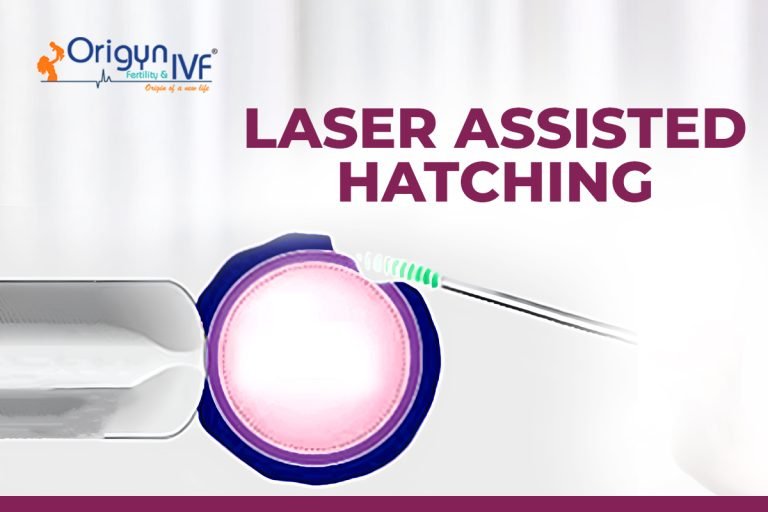
Laser Assisted Hatching is a method used in labs in the process of IVF. An embryo needs to break through its outer shell naturally, known as Zona pellucida, before it can attach itself to the uterus and begin a pregnancy. Sometimes, this shell is too thick or hardened, which makes it difficult for implantation to occur. LAH uses a gentle laser in thining the embryo’s outer shell, making it easier to hatch and implant in the uterus for a better chance at pregnancy.

LAH isn’t necessary for every IVF case, but it’s beneficial for:

  • Women who are above the age of 35.
  • Patients with previous failed IVF attempts.
  • Embryos with an abnormally thick zona pellucida.
  • Cases involving frozen-thawed embryos.
  • Poor prognosis IVF cycles.

Difference Between a Laser Assisted Hatching & Normal Conception

Aspect Normal Conception Assisted Hatching
How it happens? Sperm fertilizes the egg naturally inside the woman’s body. Embryo is created through IVF and then gently assisted to hatch.
Embryo development Embryo develops and hatches naturally inside the uterus. Embryo is helped by making a tiny hole in its outer shell (zona).
Shell (zona pellucida) Embryo breaks out of the shell on its own to implant. A laser is used to thin or open the shell for easier implantation.
Implantation Happens naturally if the embryo reaches and attaches to the uterus. It improves chances of implantation, in difficult cases.
Used For Population with no fertility problems. Beneficial in IVF failures, older women, or embryos with thick outer shells.
Technology involved No medical aid is needed. Uses a safe, focused laser under microscope during IVF.

Procedure of the Laser Assisted Hatching Treatment

Step 1 Egg Retrieval and Fertilization: Eggs are collected from the ovaries and fertilized with sperm in the lab.

Step 2 Cultured Embryo: The fertilized eggs also called embryos, are carefully grown in a lab environment for around 2 – 5 days which is under control.

Step 3 Selection of Embryo: Embryos which are healthy & in good-quality condition are selected for the assisted hatching process.

Step 4 Microscopic View: The selected embryo is then placed under a high-resolution microscope for detailed observation.

Step 5 Laser Application: A special laser is used to create a small opening in the outer shell of the embryo, making it easier for the embryo to hatch.

Step 6 Transfer of Embryo: Immediately after the hatching procedure, the embryo is gently delivered into the uterus for implantation.

Step 7 Monitoring & Support: After the transfer, the patient is observed and given necessary hormonal support to help and achieve a successful pregnancy.

Benefits, Risks & Success Rate of Laser Assisted Hatching

Benefits:

  1. Helps Older Women: Especially good for older women, where embryo shells may be harder.
  2. Improves Frozen Embryo Transfers: Freezing (vitrification) can harden the outer shell of the embryo; LAH helps soften it for easier implantation.
  3. Useful in Repeated IVF Failures: Patients who have experienced multiple failed IVF cycles may get benefit from LAH.
  4. Thick Zona in Fresh Cycles: Even in fresh IVF cycles, if the embryologist notices that the embryo’s shell is thick, LAH can help in hatching it.

Success Rate:

  • The research on LAH is still unclear, meaning there is no strong, universal evidence that it improves success rates for everyone.
  • However, in selected cases, some studies suggest that LAH may improve IVF success rates.

Risks:

  • Need Skilled Embryologists: If not done properly, there’s a risk of damaging the embryo.
  • Expensive Equipment: Laser machines are costly and not available at all the IVF centers.
  • Added Cost: The procedure adds an extra cost of 10,000 at some centers.
  • Not Universally Needed: This treatment is not beneficial for all IVF patients, and unnecessary use may not improve outcomes.

Laser Assisted Hatching at Origyn IVF

At Origyn IVF, we use the latest laser technology to ensure precision and safety in every procedure. Our expert embryologists and fertility specialists assess each case to determine if LAH can enhance implantation chances. We believe in a patient-first approach, providing customized treatments to maximize the likelihood of conception.

Cost of the Process

The cost of Laser Assisted Hatching in India is around INR 10,000 to 25,000. At Origyn IVF, this may differ based on what kind of treatment plan you opted for. Our team will provide a transparent cost breakdown and discuss whether LAH is included in your IVF package or charged separately.

Conclusion

Laser Assisted Hatching is a remarkable advancement in fertility treatment that can make a difference in the right situations. At Origyn IVF, we combine advanced technology with compassionate care to give you the highest chances of IVF success. If you’re considering IVF or have experienced repeated failures, LAH might be the supportive step you need.

Frequently Asked Questions

1. Is the treatment of LAH safe for the embryo?
Yes, it is safe when performed by trained embryologists using specialized equipment.

2. Does LAH guarantee pregnancy for all women?
No procedure can guarantee pregnancy, but LAH may improve your chances in certain cases.

3. How long does the LAH procedure take?
The laser hatching itself takes just a few seconds per embryo.

4. Does LAH damages the embryo?
No, the laser is extremely precise and only affects the zona pellucida without harming the embryo.

5. Can LAH be used with frozen embryos?
Yes, and it is often recommended since freezing can harden the outer shell.

For personalized advice or more information, consult the fertility experts at Origyn IVF today.