
IVF vs Natural Conception: 10 Key Facts To Know
Share with your friends
About Dr. Rashmi Sharma
Dr. Rashmi Sharma is an IVF specialist, Consultant Reproductive Medicine, and Director Origyn Fertility & IVF, New Delhi. She holds MBBS (BHU), MD (BHU), DNB, MNAMS, FICOG, and a Diploma in IVF & Reproductive Medicine (Kiel University, Germany). Web Editor, Indian Fertility Society (2024–26). Former HOD, IVF Department, Moolchand Hospital, Delhi (2009–13) and Max Hospital, Pitampura, Delhi (2013–17). Director, Origyn Fertility & IVF, which has 4 branches across Delhi.
Origyn IVF has been accredited for a 1-year fellowship in IVF and Reproductive Medicine, along with an MSc in Clinical Embryology under Amity University and IFS collaboration.
Recipient of the “C. S. Dawn Award” for best paper presentation on IVF/ICSI with genital tuberculosis at the All India Congress of Obstetrics and Gynecology (AICOG 2010).
Recipient of the “Hall of Fame – Best IVF Specialist in India – North” at the Economic Times National Fertility Awards in 2019, 2023, and 2024.
Origyn IVF received the “Best IVF Center in North India” and “Most Integrated Team in IVF – North” at the Economic Times National Fertility Awards in 2019 and 2024.
Recipient of the “Best IFS Executive” award at Fertivision 2018, Kochi. Authored various chapters in reputed infertility textbooks with numerous national and international publications and presentations.
Contact Us
IVF vs Natural Conception can be one of the most debated subjects among couples who want to have a child. With advances in reproductive health, people can choose more possibilities than before. However, it can also cause uncertainty.
Do you want to continue trying naturally or do you want to go for IVF? Knowing the advantages, differences and drawbacks of both options is vital to make an informed choice.
In this blog post by Origyn IVF we dissect IVF vs natural conception into 10 essential points you should be aware of.
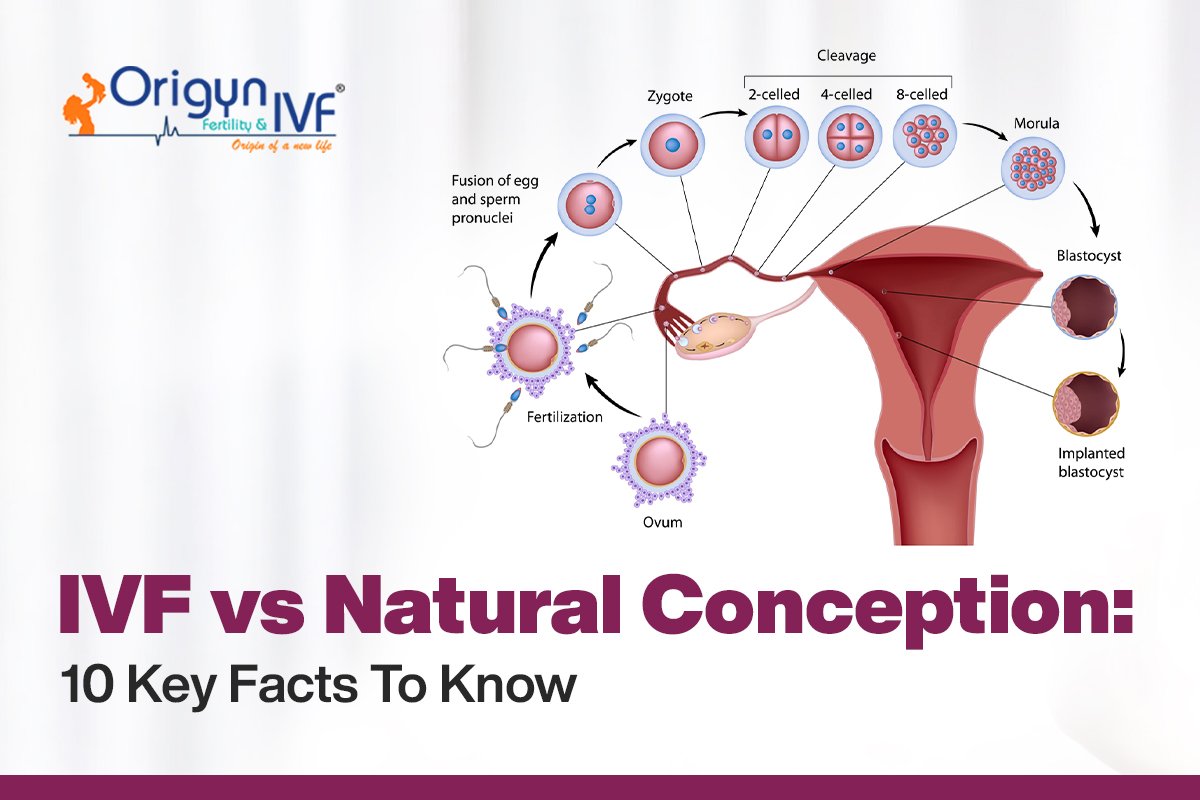
What is Natural Conception?
Natural conception is when sperm fertilizes an egg within the female organs, primarily in the fallopian tubes, without any medical intervention. It depends on several elements which are in perfect alignment: healthy fertility, sperm, open fallopian tubes, and the right timing.
What is IVF?
In-vitro fertilization (IVF) is a method of reproduction where eggs are removed from ovaries and fertilized with sperm in a lab. The resultant embryo is transferred to the uterus.
IVF vs Natural Conception: Key Facts You Should Know
IVF vs Natural Conception – Comparison Table
| Aspect | Natural Conception | IVF (In Vitro Fertilization) |
| Fertilization | Happens naturally within the female body | Occurs outside the body in a laboratory |
| Process | Sperm and egg meet in the fallopian tube | Eggs are retrieved, fertilized in the lab, and embryos are transferred to the uterus |
| Medical Involvement | No medical intervention needed (in most cases) | Highly medicalized process with continuous monitoring and procedures |
| Success Rate | 16- 20% per cycle (depends on age and health) | Higher in specific cases; depends on condition, age, and clinic |
| Time to Conceive | May take months or years | More time-controlled and planned |
| Impact of Age | Fertility declines significantly after 35 | Also declines with age but offers assisted options |
| Suitability | Ideal for couples with no fertility issues | Suitable for infertility, blocked tubes, low sperm count, etc. |
| Cost | Minimal | Expensive due to medications, lab procedures, and cycles |
| Physical Impact | No medical procedures involved | Requires injections, egg retrieval, and embryo transfer |
| Emotional Stress | Moderate due to uncertainty over time | Higher due to procedures and expectations |
| Control Over Process | Very limited control | High control (monitoring, embryo selection, and timing) |
| Genetic Testing Option | Not possible before pregnancy | Possible through PGT (pre-implantation genetic testing) |
| When Recommended | First-line approach for healthy couples | Recommended when natural conception fails or is not medically possible |
Conclusion
The choice between IVF vs natural conception depends on factors like age, medical history, and how long you’ve been trying to conceive. While natural conception is ideal for many, fertility issues can make IVF a necessary and effective option, helping couples make informed decisions rather than relying on chance.
Timing is crucial in IVF vs natural conception, as fertility declines with age and delays can reduce success rates. Seeking expert advice early helps in choosing the right path—whether to continue naturally or move to IVF—making the journey more efficient and less stressful.
At Origyn IVF, personalized care and expert guidance support couples at every step of their fertility journey. With the right approach and timely decisions, choosing between IVF vs natural conception becomes clearer, bringing you closer to achieving parenthood.
Follow us on Instagram and YouTube for more expert insights and fertility guidance.
Frequently Asked Question
1. IVF is it always the first choice to treat infertility?
Yes, IVF is not always the first choice, since doctors typically recommend experimenting with the natural method or treatments before proceeding. When discussing IVF vs natural conception, IVF is generally looked as an option when all other options fail or if medical conditions are specific to the situation.
2. Do lifestyle changes increase the chances for natural conception?
Yes, lifestyle changes such as a balanced diet, regular exercise, and a healthy stress level can greatly increase the chances of a successful fertility. If you are comparing IVF vs natural conception lifestyle changes can occasionally help couples to conceive naturally without having to undergo IVF.
3. What number of IVF cycles are typically required?
The no. of IVF cycles is contingent on fertility factors specific to each person’s age, medical conditions. In some cases, couples might require multiple attempts. In IVF vs natural conception, IVF offers repeated controlled and controlled chances, in contrast to natural conception that is dependent on the chance of conception each month.
4. Does IVF cause pain?
IVF is a process that involves specific procedures, such as egg retrieval and injections, that can cause minor discomfort, but they are typically managed with medical treatment. In the case of IVF vs natural conception IVF is more physically intensive. However, advancements have made it more accommodating to patients.
5. Can IVF guarantee pregnancy?
There is no way to guarantee pregnancy. IVF does not guarantee pregnancy, but it can significantly increase odds compared to non-treated infertility cases. If you are using IVF vs Natural conception both methods have high success rates however IVF offers an improved and more efficient method, rather than a guarantee.