
• 80 80 80 90 84
  • info@origynivf.com
Curious About IVF? Let's Talk.
  • January 30, 2026

Effective Difference Between Short Protocol & Long Protocol in IVF

Share with your friends

About Dr. Rashmi Sharma

Dr. Rashmi Sharma is an IVF specialist, Consultant Reproductive Medicine, and Director Origyn Fertility & IVF, New Delhi. She holds MBBS (BHU), MD (BHU), DNB, MNAMS, FICOG, and a Diploma in IVF & Reproductive Medicine (Kiel University, Germany). Web Editor, Indian Fertility Society (2024–26). Former HOD, IVF Department, Moolchand Hospital, Delhi (2009–13) and Max Hospital, Pitampura, Delhi (2013–17). Director, Origyn Fertility & IVF, which has 4 branches across Delhi.

Origyn IVF has been accredited for a 1-year fellowship in IVF and Reproductive Medicine, along with an MSc in Clinical Embryology under Amity University and IFS collaboration.

Recipient of the “C. S. Dawn Award” for best paper presentation on IVF/ICSI with genital tuberculosis at the All India Congress of Obstetrics and Gynecology (AICOG 2010).

Recipient of the “Hall of Fame – Best IVF Specialist in India – North” at the Economic Times National Fertility Awards in 2019, 2023, and 2024.

Origyn IVF received the “Best IVF Center in North India” and “Most Integrated Team in IVF – North” at the Economic Times National Fertility Awards in 2019 and 2024.

Recipient of the “Best IFS Executive” award at Fertivision 2018, Kochi. Authored various chapters in reputed infertility textbooks with numerous national and international publications and presentations.

Contact Us

Blank Form (#7)

In-vitro fertilization also called as IVF has emerged as a powerful solution for couples facing infertility problems. At the heart of IVF lies ovarian stimulation, a process which is essential for retrieving multiple healthy eggs.

Two major strategies guide this stimulation are the Short Protocol & Long Protocol in IVF. But what did you understood by these terms? How are they different from each other, and which one is suitable for you? This blog covers everything that will help you to differentiate between both the terms.

At Origyn IVF,  a leading fertility centre in Delhi is renowned for IVF treatments under the supervision of Dr. Rashmi Sharma & her specialized team.
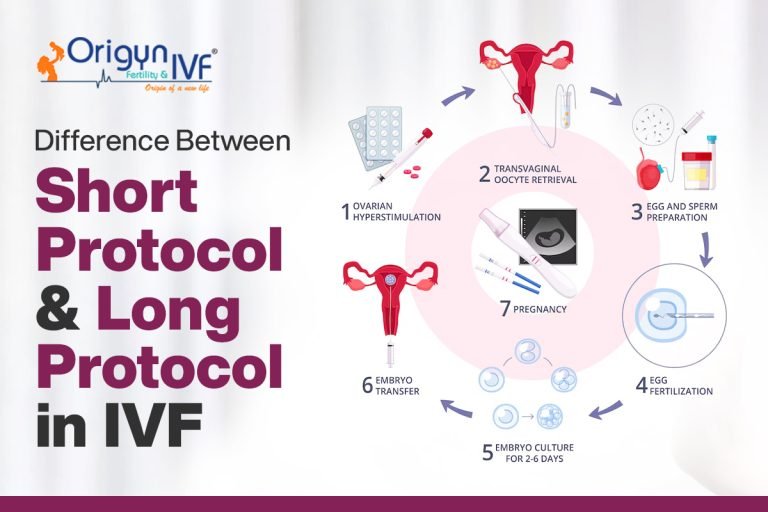
Short Protocol & Long Protocol in IVF

Understanding IVF Stimulation Protocol

IVF stimulation protocols are structured hormone treatments that are designed to stimulate the ovaries to produce multiple eggs. This increases the chances of successful fertilization. It depends on the woman’s hormonal profile and ultrasound findings, doctors may choose between a Short Protocol & Long Protocol in IVF. Each has it’s own specific timings, medications, and goals, all modified to maximize your chances of success.

What is Short Protocol in IVF?

The Short Protocol in IVF is often preferred for women with a good ovarian reserve or those needing quicker stimulation. In this method:

  • After a baseline ultrasound, stimulation starts on Day 2 or Day 3 of the menstrual cycle.
  • The scan ensures that the uterus lining and ovaries are in optimal condition so no cysts, no irregular follicles.
  • If everything goes normal, the doctor immediately begins stimulation with injectable hormones known as gonadotropins.
  • These hormones help mature multiple follicles at once.

The Short Protocol is more straightforward, faster but requires fewer medications and monitoring visits.

What is Long Protocol in IVF?

The Long Protocol in IVF is a more controlled and extensive method. It is usually recommended when:

  • Baseline ultrasound shows cysts, incoherent follicular sizes, hormonal imbalances.
  • Before beginning stimulation, the doctor wants to regulate hormone levels.

In this method:

  • Preparations begin a month in advance.
  • Oral contraceptive pills are prescribed for 21 days to balance hormones.
  • Additionally, a GnRH agonist injection may be administered around Day 21 of the previous cycle.
  • After hormonal suppression is confirmed, ovarian stimulation begins with gonadotropins.

The Long Protocol provides a more synchronized hormonal environment and is often used in complex or first-time IVF cases. 

Key Differences Between Short Protocol & Long Protocol in IVF

Factor Short Protocol Long Protocol
Start Time Day 2 or 3 of menstrual cycle One month prior to stimulation
Duration Shorter (approx. 10–14 days) Longer (approx. 4–6 weeks)
Initial Medications Direct stimulation with gonadotropins Pre-treatment with contraceptives/ GnRH agonists
Hormonal Regulation Minimal Extensive
Best For Good responders, younger women Hormonal imbalances, irregular scans
Cost & Visits Fewer injections and visits More medicines and monitoring

Both Short Protocol & Long Protocol in IVF have their advantages. The choice often depends on how the ovaries appear and respond early in the cycle.

How Doctors Decide Which Protocol To Use?

On Day 2 or Day 3 of your cycle, a baseline transvaginal ultrasound is conducted. Doctors look for things to know the difference between short Protocol & long protocol in IVF:

  • Absence of cysts
  • Balanced hormone levels
  • Uniform follicle sizes
  • Proper endometrial lining

If the scan is clear, the Short Protocol is often initiated immediately. If there are abnormalities, such as large follicles or irregular growth patterns, the doctor may shift to a Long Protocol to first regulate hormones and prepare the body more thoroughly.

Side Effects and Considerations

Both short protocol & long protocol in IVF involve hormone injections, and while generally safe, they can have side effects like:

  • Mild bloating or abdominal discomfort
  • Mood swings or irritability
  • Rarely, Ovarian Hyperstimulation Syndrome (OHSS)

In the Long Protocol, due to hormonal suppression, you may feel temporary fatigue or headaches. However, the careful planning helps avoid last-minute surprises during egg retrieval.

Short Protocol & Long Protocol in IVF: Which is Better?

There is no one-size-fits-all answer. The Short Protocol is best for younger women with predictable cycles and good ovarian reserves. It’s quicker, more affordable, and often easier to manage at home. The Long Protocol in IVF is more structured and offers better hormonal control, especially for women with complex fertility histories.

The protocol which is better depends entirely on your personal medical history, age, and ovarian response.

Origyn IVF’s Approach to Personalized IVF Protocols

At Origyn IVF, we believe that personalization is the cornerstone of success. Our team conducts comprehensive evaluations before recommending a protocol. If it’s a Short Protocol for its simplicity and efficiency, or a Long Protocol for thorough hormonal preparation, our focus remains on achieving the best possible outcome with minimal stress for you.

We also train couples to self-administer injections safely, making the process more convenient and empowering.

Conclusion

Understanding the difference between Short Protocol & Long Protocol in IVF can empower you to take an active role in your fertility journey. Both have their unique strengths and are chosen based on your individual medical profile and fertility goals. At Origyn IVF, we recognize that no two patients are the same and that’s why your treatment plan isn’t either.

With the right medical guidance, thorough assessment, and personalized planning like the compassionate, patient-centric approach followed at Origyn IVF, you’re not just undergoing a procedure, you’re stepping into a hopeful path tailored just for you. If your journey begins with the Short Protocol or the Long Protocol, our expert team walks with you at every step, helping turn your dream of parenthood into a beautiful reality.

Frequently Asked Questions

Q1. Is Short Protocol better than Long Protocol?

Not necessarily. The Short Protocol is quicker but suits specific patient types. The Long Protocol is more comprehensive and often used in complex cases.

Q2. Why are birth control pills given in the Long Protocol?

They help balance hormones and regulate the ovarian environment before stimulation.

Q3. Are the injections painful?

No. Most are subcutaneous (under the skin) and can be self-administered at home, often on the abdomen.

Q4. Can I switch from short protocol & long protocol in IVF?

Yes, depending on how your body responds during the early cycle days, your doctor may adjust the protocol.

Q5. How many injections are needed?

It varies, but usually between 8–12 injections during the stimulation phase.