
• 80 80 80 90 84
  • info@origynivf.com
Curious About IVF? Let's Talk.
  • January 30, 2026

Key Difference Between IVF, ICSI and IUI: How to Choose One?

Share with your friends

About Dr. Rashmi Sharma

Dr. Rashmi Sharma is an IVF specialist, Consultant Reproductive Medicine, and Director Origyn Fertility & IVF, New Delhi. She holds MBBS (BHU), MD (BHU), DNB, MNAMS, FICOG, and a Diploma in IVF & Reproductive Medicine (Kiel University, Germany). Web Editor, Indian Fertility Society (2024–26). Former HOD, IVF Department, Moolchand Hospital, Delhi (2009–13) and Max Hospital, Pitampura, Delhi (2013–17). Director, Origyn Fertility & IVF, which has 4 branches across Delhi.

Origyn IVF has been accredited for a 1-year fellowship in IVF and Reproductive Medicine, along with an MSc in Clinical Embryology under Amity University and IFS collaboration.

Recipient of the “C. S. Dawn Award” for best paper presentation on IVF/ICSI with genital tuberculosis at the All India Congress of Obstetrics and Gynecology (AICOG 2010).

Recipient of the “Hall of Fame – Best IVF Specialist in India – North” at the Economic Times National Fertility Awards in 2019, 2023, and 2024.

Origyn IVF received the “Best IVF Center in North India” and “Most Integrated Team in IVF – North” at the Economic Times National Fertility Awards in 2019 and 2024.

Recipient of the “Best IFS Executive” award at Fertivision 2018, Kochi. Authored various chapters in reputed infertility textbooks with numerous national and international publications and presentations.

Contact Us

Blank Form (#7)

When you’ve been trying for a baby and nothing seems to be working, it can take a real emotional toll — and honestly, that’s completely okay. It’s normal to feel frustrated, tired, or even lost at times.

If you’ve started searching for IVF options in 2025, then you must have come across terms such as IVF, ICSI, IUI and more, which can be really confusing at first. So let’s understand them:

  • What do all these terms mean?
  • How are they different?
  • Which one is right for you?

Whether you’re wondering which option would be perfect for you or you’re just starting your journey, this blog will simplify it all — especially the difference between IVF, ICSI and IUI.
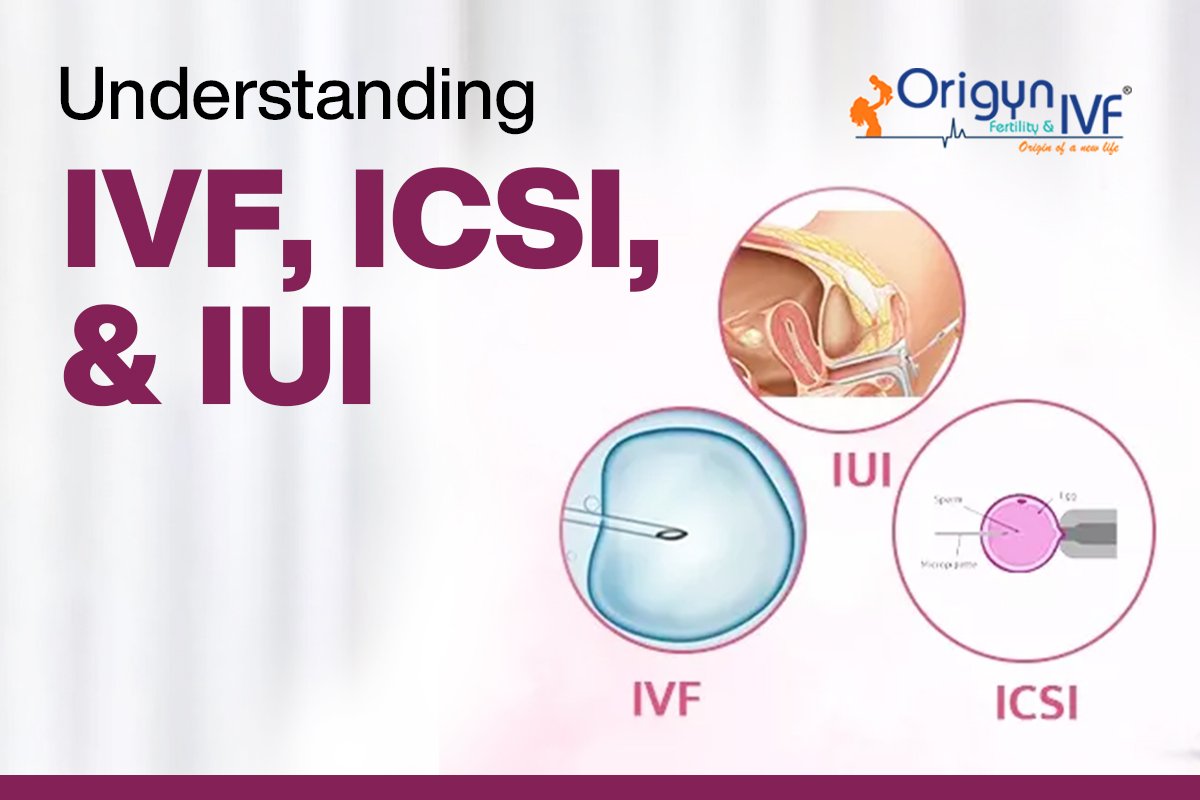
Difference Between IVF

IUI (Intrauterine Insemination): The Gentle First Step

IUI is considered the best option when the fertility complications aren’t major. It is the least invasive and just ‘gives a little push’.

Here is how it works – around the time when you are ovulating, a sample sperm (of your partner) is carefully put inside your uterus. This procedure gives the sperm a push towards the uterine cavity to move closer to the egg, which increases the chances of successful fertilisation.

When is IUI usually recommended?

  • If you’re facing mild male infertility (like slightly low sperm count or motility)
  • If there is a problem with cervical mucus
  • If you’re using donor sperm
  • Or if you have unexplained infertility

Why people like it :

  • It’s quick and relatively painless
  • Less expensive than IVF or ICSI
  • No surgery or egg retrieval involved

The flip side :

  • It has lower success rates (around 16–20% per cycle)
  • It might take multiple attempts to see results
  • It’s not ideal for more complex fertility challenges.

If you’re trying to understand the difference between IVF, ICSI and IUI, remember that IUI is often the first step due to its simplicity and lower cost.

IVF (In Vitro Fertilization): A More Hands-On Approach

IVF is the first fertility treatment that comes to mind — and that’s for a good reason. Over the years, this treatment has turned many couples into parents. IVF is known to be the safest and most effective solution, especially when other treatments haven’t shown positive results.

From hormone stimulation to embryo transfer, IVF gives doctors control over each stage of the process, which can be crucial when dealing with complicated fertility issues.

What actually happens?

  1. Your ovaries are stimulated with hormone injections to produce more eggs.
  2. The eggs are retrieved from your ovaries.
  3. They’re fertilized in a lab with sperm.
  4. The resulting embryos are watched carefully.
  5. The best embryo is placed back in the uterus.6. If all goes well, implantation happens — and so does pregnancy.

IVF is often used when:

  • Fallopian tubes are blocked or damaged
  • There’s moderate to severe endometriosis
  • Age is a factor (especially over 35)
  • You’ve already tried IUI without success
  • There’s unexplained infertility

What’s great about IVF:

  • Higher success rate (30–50% depending on age)
  • Gives doctors more control
  • You can freeze embryos for later use
  • Allows for genetic testing of embryos if needed

What to keep in mind :

  • It’s more invasive and expensive
  • Hormone meds can cause side effects
  • Requires more time, planning, and emotional preparation

When comparing the difference between IVF, ICSI and IUI, IVF is a more intensive process than IUI but is suitable for more complex or long-term infertility challenges.

ICSI (Intracytoplasmic Sperm Injection): Precision at Fertilization

ICSI is actually a type of IVF, but with a key difference during the fertilization step. Instead of mixing sperm with the egg, one healthy sperm is carefully injected directly into the egg using a microscopic needle.

This method is a game-changer when sperm quality is poor or if previous IVF attempts have failed.

ICSI is recommended when:

  • Sperm count is very low
  • Sperm has poor motility or abnormal shape
  • Fertilization failed during a previous IVF cycle
  • Sperm is surgically retrieved (like after a vasectomy)
  • There are issues with ejaculation or blockages

Why choose ICSI?

  • Helps overcome severe male infertility
  • Requires only a small number of sperm
  • Fertilization rates are often higher in male factor infertility cases

Things to keep in mind:

  • It involves all the same steps and costs as IVF (plus extra for the ICSI procedure)
  • ICSI doesn’t guarantee pregnancy just fertilization
  • Like IVF, it requires time, preparation, and emotional readiness

The difference between IVF, ICSI and IUI becomes especially clear here: ICSI is chosen when fertilization is the biggest hurdle, particularly due to male infertility factors.

At a Glance: Understanding the Difference Between IVF, ICSI and IUI

Still confused? Here’s a quick comparison chart to help you understand the difference between IVF, ICSI and IUI more clearly

Feature IUI IVF ICSI
Invasiveness Least invasive, like a basic procedure Moderately invasive, includes egg retrieval Most invasive, involves precise sperm injection
Where Fertilization Happens Inside the woman’s body (natural-like) In the lab (outside the body) In the lab (with direct sperm injection)
Sperm Requirement Normal or mildly low sperm count Normal to mildly affected sperm Very few or poor-quality sperm
Cost Most affordable More expensive Most expensive
Success Rate 10–20% per cycle 30–50% per cycle Similar to IVF (depends on condition)
Ideal For Mild fertility problems Blocked tubes, age issues, or unknown causes Severe male infertility or failed IVF

This comparison table gives a bird’s eye view of the difference between IVF, ICSI and IUI in terms of procedure, complexity, and success rate.

Difference Between IVF, ICSI and IUI: Which One Is Better?

Here’s the thing: there’s no one-size-fits-all answer. The best fertility treatment depends on:

  • Your age
  • The cause of infertility (if known)
  • How long you’ve been trying
  • Your emotional and financial readiness
  • Medical guidance from a fertility specialist

Some people start with IUI and move to IVF later. Others begin directly with IVF or ICSI depending on the situation. It’s not a race or a competition — it’s about what gives you the best chance of success. Understanding the difference between IVF, ICSI and IUI is the first step in making a confident, informed decision.

Conclusion

Trying for a baby and seeing no positive results can feel emotionally overwhelming and then going for a fertility treatment can feel like another mental rollercoaster. Whatever optionsyou go for – whether it is IUI, IVF or ICSI, you need to have patience, hope and believe that you are doing everything you can for the future you wish for. You are not alone and many people have gone through these procedures. I would suggest you explore every option, have a full-on conversation with your doctors and openly ask all sorts of doubts from them.

FREQUENTLY ASKED QUESTION [ FAQs]

1. Is IUI less expensive than IVF or ICSI?

Yes, IUI is usually the most affordable option among the three. It involves fewer medications and procedures. IVF and ICSI are more complex and require lab work, medications, and sometimes surgery, which makes them more costly.

2. Which treatment would be suitable for me ?

The best treatment for you depends on your diagnosis, age, fertility goals, and medical history. A fertility specialist will run a few tests to help decide whether you should start with IUI or move directly to IVF or ICSI.

3. How many cycles will I need to get pregnant?

This varies from person to person. Some couples conceive in the first or second cycle, while others may need multiple rounds. Your doctor will adjust the approach based on how your body responds.